
Sports-related groin pain can affect athletes at every level, from professionals to active adults, and accurate diagnosis is essential for proper treatment. Under the direction of Dr. Treen — an accomplished surgeon with decades of experience in hernia and abdominal wall conditions — the Hernia Institute of Louisiana offers a thoughtful, individualized approach to evaluating sports hernias.
With careful assessment and a range of surgical and non-surgical procedures, patients receive guidance that supports safe healing and a return to activity.

What Is a Sports Hernia?
Over the last several years, more and more publicity has emerged around professional athletes undergoing surgery for a “sports hernia.” In fact, the condition is perhaps more accurately labeled athletic pubalgia (pain in the pubic region).
A sports hernia is actually not a hernia at all. It is thought to involve a disruption of connective tissue in the pelvis, in or near the inguinal region, which is caused by an imbalance of muscular and tendinous forces focused in the groin.
Common Sports Hernia Symptoms
Sports hernia symptoms typically center around persistent groin pain that develops gradually and worsens with physical activity. Athletes often notice discomfort during sprinting, cutting, twisting, kicking, or sudden directional changes. The pain may affect the inner thigh, lower abdomen, or pubic area and often improves with rest, only to return when activity resumes.
Unlike a traditional hernia, there is usually no visible bulge. Some individuals experience weakness, stiffness, or a pulling sensation in the groin. Tenderness in the lower abdominal or adductor region is also common, particularly during sit-ups or resisted hip movements.
Videos
Causes of Sports Hernias
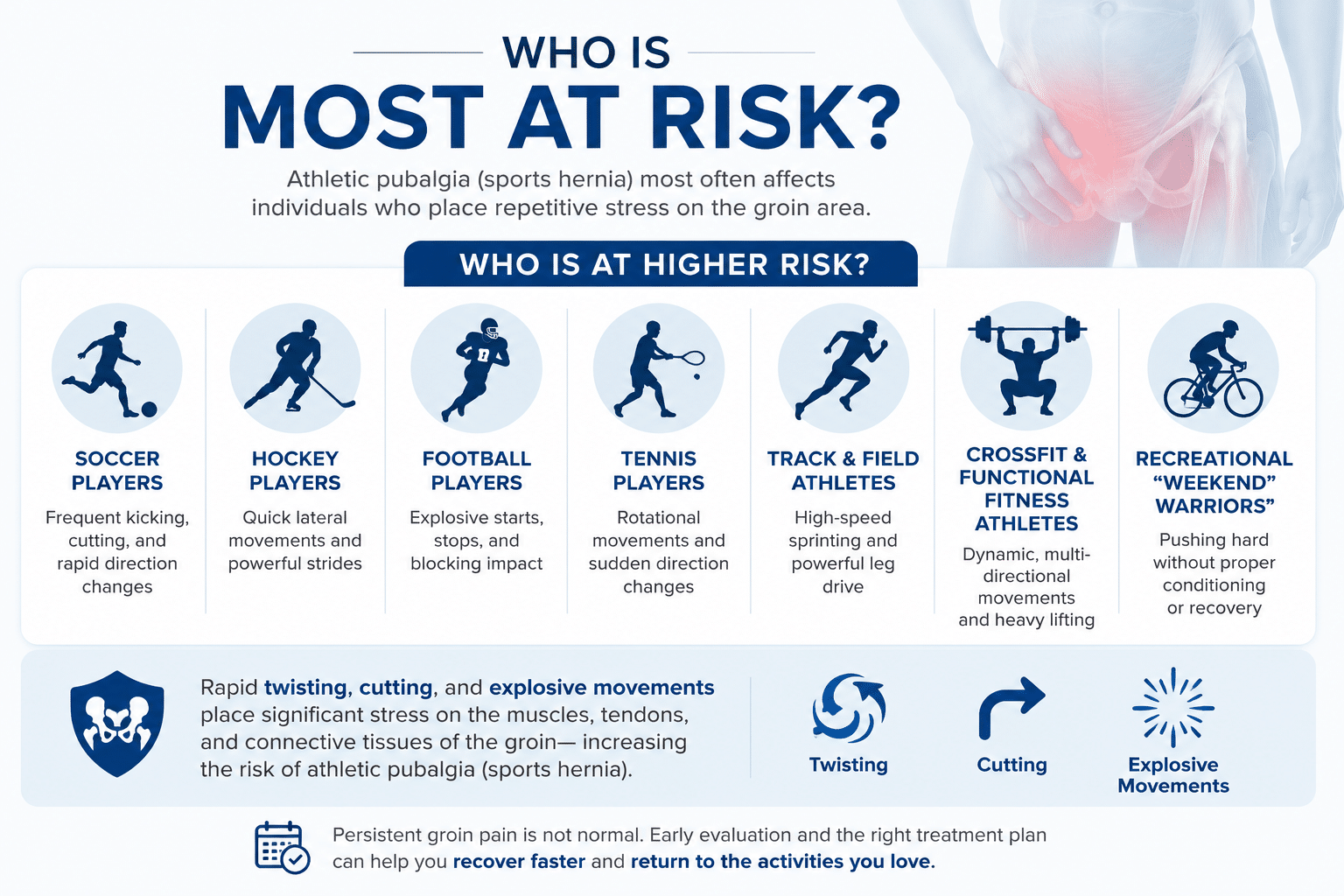
This condition most commonly occurs during athletic activities that require certain motions of the hip, thigh, and abdominal muscles. Soccer and hockey players seem to be at the greatest risk. Still, any activity that places stress on this area can produce symptoms of a sports hernia, especially when conditioning is somewhat unbalanced.
Professional athletes are not the only ones at risk. In fact, it is likely that non-professional athletes and “weekend warriors” produce more injuries.
Diagnosing Sports Hernias
Diagnosis can be challenging, as diagnostic imaging studies such as MRI, CT scan, and ultrasound are often normal or inconclusive. Careful evaluation, including analysis of the mechanisms underlying the pain and targeted physical examination, is usually the only way to accurately diagnose this condition.
Treating Sports Hernias
Experts in the field debate the appropriate treatment for this condition, and there is no clear consensus on which surgical approach is preferable.
Our approach is to avoid the “one surgery fits all” mentality and to devise a treatment plan suitable for the patient, their condition, and the urgency of returning to similar athletic activity. Clearly, professional athletes need to be “back in the game” as soon as possible. Still, it is important to allow adequate healing, whether or not surgery is involved, before resuming full participation.
For some, surgery is not required. Quality physical therapy with a competent and knowledgeable therapist, combined with gradual strengthening exercises, can yield excellent results.
Surgical options for sports hernia include minimally invasive laparoscopic repair with lightweight mesh and minimal-incision “open” bilayer mesh repair with the Prolene Hernia System or UltraPro Hernia System. Release of the adductor muscle tendon in the groin is occasionally advised, but is employed very judiciously.
Recovery
Professional athletes can usually return to the field of play in as little as 2 weeks, but 3-4 weeks is the average. Others, depending on the level of conditioning and need for therapy after surgery, can require up to 6-8 weeks for adequate recovery.
Why Choose the Hernia Institute of Louisiana for Sports Hernia Repair in New Orleans?
Patients seeking sports hernia repair in New Orleans benefit from the Hernia Institute of Louisiana’s focused expertise and thoughtful, case-by-case approach to care. Under the leadership of Dr. Treen, a surgeon with decades of experience in groin-related injuries and abdominal wall conditions, the practice offers precise evaluation and treatment options that reflect each patient’s athletic demands and recovery goals.
FAQs
How Is a Sports Hernia Different From a Traditional Inguinal Hernia?
A sports hernia involves strain or tearing of soft tissues in the lower abdomen or groin without creating a visible bulge. A traditional inguinal hernia occurs when abdominal contents push through a weakened area of the abdominal wall, often forming a noticeable lump.
Sports hernias primarily cause activity-related groin pain, while inguinal hernias may produce pressure, heaviness, or a bulge that becomes more apparent when coughing or lifting.
Can a Sports Hernia Heal Without Surgery?
Some mild cases improve with rest, anti-inflammatory measures, and structured physical therapy focused on core and hip stability.
Reducing inflammation and correcting muscle imbalances can relieve symptoms for certain patients. However, if pain persists for several weeks or recurs with activity, surgical repair may be considered.
An evaluation helps determine whether non-surgical care is likely to provide lasting relief.
Who Is Most at Risk for Developing Athletic Pubalgia?
Athletes who play sports that involve rapid acceleration, cutting, twisting, or forceful kicking are at greater risk. Soccer, hockey, football, tennis, and track athletes commonly experience this condition. Individuals with core weakness, muscle imbalances, or inadequate conditioning may also be more susceptible.
Both competitive athletes and recreational “weekend warriors” can develop athletic pubalgia when repetitive stress strains the groin region.
Sports hernias primarily cause activity-related groin pain, while inguinal hernias may produce pressure, heaviness, or a bulge that becomes more apparent when coughing or lifting.
What Happens if a Sports Hernia Is Left Untreated?
Without proper treatment, symptoms often persist or gradually worsen. Ongoing strain may lead to chronic groin pain that limits athletic performance and daily activities.
Athletes may compensate with altered movement patterns, increasing the risk of additional injuries to the hip, lower back, or pelvis. Early evaluation allows for targeted management, which may prevent prolonged discomfort and extended time away from sports.
How Long Should I Wait Before Seeking Evaluation for Groin Pain?
If groin pain lasts more than two to three weeks despite rest and activity modification, a medical evaluation is recommended. Pain that repeatedly returns during sports participation or interferes with performance should not be ignored.
Early assessment helps determine whether the discomfort is related to athletic pubalgia or another condition, enabling a focused treatment plan and a safer return to activity.
What Types of Imaging Are Used to Evaluate Sports Hernias?
Imaging studies can rule out other causes of groin pain rather than definitively diagnose a sports hernia:
- MRI is the most commonly ordered test because it can identify soft-tissue inflammation, tendon injuries, and pubic bone stress fractures.
- Ultrasound may help evaluate the inguinal region dynamically, especially during movement.
- CT scans are less commonly used but can assess surrounding structures.
Because imaging results may appear normal, diagnosis frequently relies on history and physical examination.
Explore Sports Hernia Repair Options Today
If you’re experiencing persistent groin pain and want a clear evaluation of your condition, the Hernia Institute of Louisiana provides focused guidance and experience you can rely on. Dr. Treen and his team carefully identify the true source of your symptoms and discuss a treatment plan that fits your goals, activity level, and recovery needs.
To speak with our staff or request more information, contact the Hernia Institute of Louisiana in Metairie at 504-218-4922.